Telling a male budgie from a female is the number one question new owners ask, and it is not always easy. The good news: for most budgies the cere, the fleshy patch above the beak where the nostrils sit, gives you a reliable clue once the bird is mature.
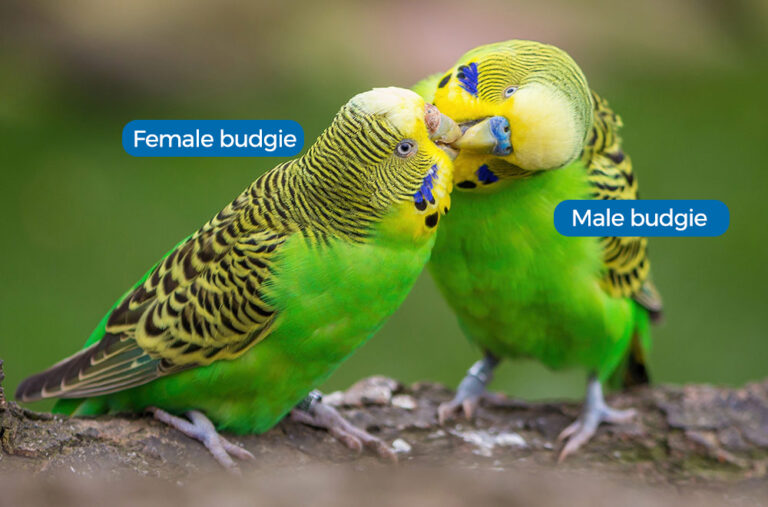
Quick answer: in most adult budgies, a blue cere means male and a tan, brown or whitish cere means female. Young birds and some color varieties are trickier, so use the chart below.
Cere color chart by age
| Age | Male | Female |
|---|---|---|
| Baby (under ~3 months) | Pinkish or purplish-pink | Pale, whitish-blue or light pink with a white ring around the nostrils |
| Young adult (3–12 months) | Pink to blue, turning solid blue | Whitish to light beige, getting a brown tone |
| Adult | Bright blue (or purple-pink in some males) | Tan, light brown or white; becomes darker and crusty brown when breeding |
Download the printable cere color chart (PDF, large file)
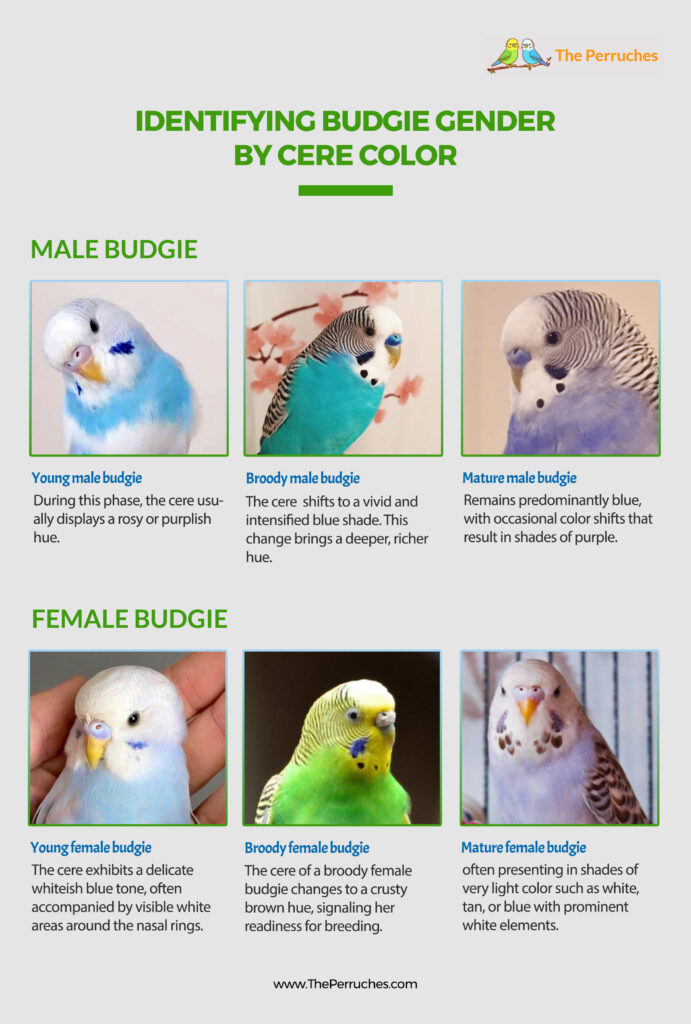
Watch out: exceptions
- Lutino, albino and recessive pied (Dark-eyed Clear) males often keep a pink or purplish cere their whole life, so pink does not always mean female.
- Opaline and some other varieties can have a slightly different shade.
- Hormones change the cere. A female coming into breeding condition can develop a thick, crusty, dark brown cere. A male can look pale during molting or illness.
- Cere color can fade or darken with age, health and season.
If your bird is one of the exception varieties, rely on the other clues below, and on a DNA test if you need certainty.
Behavior clues (helpful, not proof)
These are tendencies, not rules.
Males are often:
- Chattier and more likely to sing, mimic and “talk”
- Quick to show off, tap their beak on toys and mirrors and feed their toys
- Bobbing the head and puffing the chest toward another bird or you
Females are often:
- Quieter and more independent
- More likely to chew, shred paper and look for nest spots
- Territorial or bitey during breeding season
Plenty of females chatter and plenty of males are quiet, so use behavior only as a hint.
Physical clues
- Feet and legs do not tell the sex.
- Size does not either.
- Feathering: this does not separate males from females.
The only certain methods
- DNA test (feather or blood sample). It is the most reliable test and can be done at any age. Many avian labs and vets offer it, and it is usually affordable.
- An egg. If your budgie lays an egg, she is female. This can happen even with no male present.
- A vet exam. An avian vet can sometimes confirm sex, especially in adults.
Why does it matter?
- Housing pairs. Two females can fight over territory and nests, while two males are often happy together. See two budgies are better than one.
- Breeding: you need a confirmed male and female. Read the breeding guide.
- Health: egg-laying females can have special needs, such as extra calcium and a safe nesting area.
- Naming: a surprise at 6 months is easier if you pick a gender-neutral name for now.
Telling the sex of a sick or molting budgie
A sick or stressed budgie can have a pale or discolored cere, and a molting male can look dull, so judging the sex at that moment can mislead you. Check again when your bird is healthy and its feathers have grown back. If you need to know now, a DNA test from a single feather works even when the bird is unwell. Handle a sick bird as little as possible, and read about the warning signs in our guide to common budgie diseases.
FAQ
At what age can you tell a budgie’s gender? Often from about 3 to 4 months, when the cere starts to change. A DNA test works at any age.
Why is my female budgie’s cere blue? Some females, especially certain varieties or birds with a hormonal imbalance, can have a bluish cere. Check with a DNA test or a vet.
My budgie has a pink cere, is it male or female? In a baby it can be either. In an adult of a standard color, pink usually means female or an immature male. In lutino, albino or recessive pied birds a pink cere is common in males.
Can a female budgie turn into a male? No, but cere color can change with hormones, so the bird may look different from season to season.
Do male budgies talk more? Often, yes, but it varies from bird to bird.
Final thoughts
For most budgies the cere tells the story: blue for males and tan or brown for females. Use age, variety and behavior as extra clues, and choose a DNA test if you need to be sure. For what comes next, see our budgie growth stages and behavior guide.
More to read
Try it: our free budgie color genetics calculator shows the chance of every chick color for any pairing.